Mobile specimen collection lets a diagnostic lab extend its reach beyond its own draw sites by sending a technician to a patient’s home, workplace, or another location, then returning the specimen to the lab. This guide is for Lab Directors and VPs of Operations at independent and hospital-affiliated labs who are evaluating an outsourced collection partner. It covers where a current vendor relationship tends to break down as a lab grows, and what to check before you bring on a new one.
What is mobile specimen collection for clinical labs?
Mobile specimen collection for labs is a service that sends a trained technician to collect a specimen at a patient’s home, workplace, or another location, using the lab’s own collection kit and tube requirements, then delivers it back to that lab for processing. Labs often bring it in to extend their reach into markets or patient populations their own draw sites cannot easily cover.
Where the break happens
One pattern we’ve seen in lab conversations is not a complaint about phlebotomy itself. It is a complaint about coverage. A lab contracts with a smaller regional phlebotomy service to handle draws outside its own sites. That works while the lab’s footprint is small. As the lab adds referral sources, expands into new markets, or takes on more volume, the vendor’s coverage does not keep pace. The lab is left patching gaps market by market, often without much warning until a patient in a new area cannot get a draw scheduled.
This is a different problem than staffing or compliance. It is a scale problem: the vendor a lab picked for one footprint cannot carry a bigger one.
Readiness checklist: is your current setup built to scale?
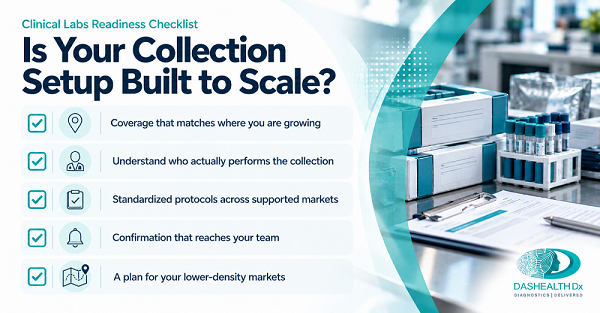
- Coverage that matches where you are growing. Before switching, confirm that the vendor can support the markets that matter to your current footprint and near-term expansion plans.
- Understand who actually performs the collection. Ask whether technicians are directly employed, contracted, or supplied through local partners, and how you maintain consistency and accountability as coverage expands.
- Standardized protocols across supported markets. Your collection kit and tube requirements should follow a consistent process, regardless of which supported market the collection occurs in.
- Confirmation that reaches your team, not just a scheduled visit. You should know a collection was completed without having to chase the status down.
- A plan for your lower-density markets. Every vendor looks strong where it’s busiest. The edges of a vendor’s coverage are where an existing relationship can start to strain.
If several of these questions are difficult to answer clearly, the collection model may deserve a closer look before the lab expands further.
What protocol-driven collection looks like
DASHealth Dx provides national mobile specimen collection through a centrally coordinated service model. Technicians are directly employed, not independent contractors; operations are centralized, and collection protocols are standardized across the markets we serve. In practice, that means your lab’s collection kit and specimen requirements move through a standardized collection process, your team gets a portal notification when each collection is completed, and you work through one accountable operating team across the markets we support. Coverage for the specific markets your lab needs is confirmed before onboarding.
We will not tell you this guarantees a result for your specific footprint. Your markets, your patient population, and your growth plans are your own. The right way to test fit is against where your current setup is actually breaking down.
Yes. Technicians work from the lab's own collection kit and specimen requirements, including tube type, for each collection.
Yes. Technicians work from the lab's own collection kit and specimen requirements, including tube type, for each collection.
No. DASHealth Dx collects and delivers specimens. It does not handle, produce, or report lab results.
If your current vendor's coverage is not keeping up with where your lab is headed, send us a message.