
Mobile Specimen Collection for Health Plans: Why It Breaks at Scale and What to Ask Before You Move Volume
Mobile specimen collection for health plans only works if ordered labs turn into completed labs, across the markets the program needs to serve, at the volume the plan actually sends. This guide is for health plan and MCO leaders in quality, care management, and vendor sourcing. It explains why mobile collection models tend to struggle as volume grows, and gives you five questions to ask any vendor before you move more members onto them.
What is mobile specimen collection for health plans?
Mobile specimen collection for health plans is a service that sends a trained technician to a member’s home or another convenient location to collect a lab specimen, then delivers it to the lab. It is often used for members who are unlikely to reach a draw site, reducing a barrier that can keep ordered labs from being completed. The need is simple. Some members are homebound. Some live far from the nearest patient service center. Some never make the trip. The order goes in, the lab never happens, and the gap stays open.
Why lab completion matters for HEDIS and Star Ratings
HEDIS (Healthcare Effectiveness Data and Information Set), maintained by NCQA, is the set of performance measures health plans use to report quality of care. Some HEDIS measures rely on lab results. For those measures, an order alone does not close the gap. That is why quality leaders tend to look at mobile collection through a quality-performance lens. One health plan clinical leader told us their first reaction to mobile collection was about the testing tied to quality performance. The job is not simply completing a visit. It is completing the collection correctly so the lab can do its part.
Why mobile collection breaks at scale
When mobile collection struggles at scale, the operating model behind it is the first place to look. In our conversations with health plan and MCO leaders, this theme stands out. Some have already tried mobile collection, and the vendor did not hold up once volume grew. One plan leader put it plainly: they had worked with mobile vendors that were no longer scalable.
These are the parts of an operating model worth inspecting as volume grows:
-
- A contractor-heavy workforce. Ask how capacity is secured as volume grows, who is accountable for technician availability, and how consistency is maintained across markets.
-
- A patchwork of local subcontractors. Extending coverage through multiple local partners can add handoffs, operating standards, and coordination points the plan must understand before scaling.
-
- Accountability. Ask who owns the answer when a visit fails in one market: one partner, or a chain of referrals.
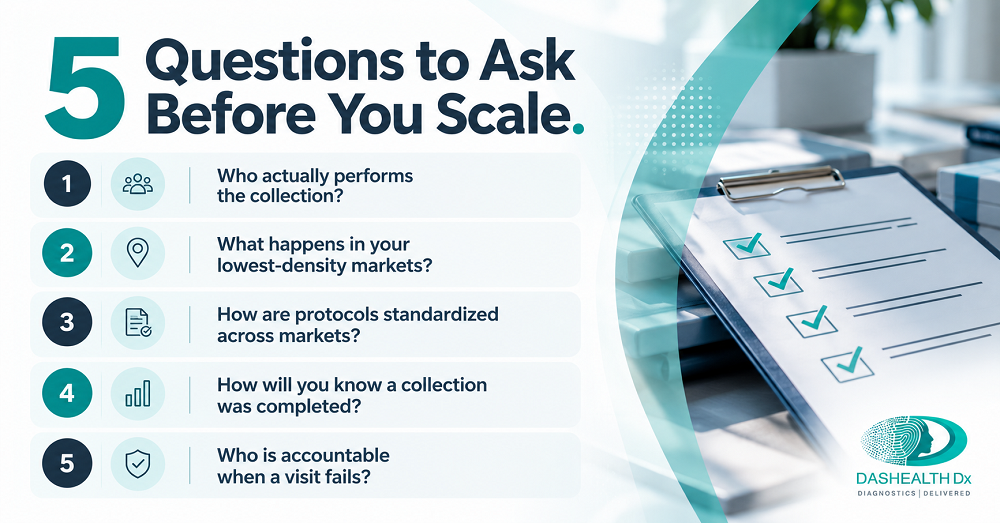
5 questions to ask a mobile specimen collection vendor before you scale
To find out whether a vendor can carry network volume, ask these five questions before you move more members.
-
- Who actually performs the collection? Employed technicians, contractors, or subcontracted local services? Ask for the mix, not the marketing line.
- What happens in your lowest-density markets? Every vendor looks strong where it is busiest. Ask about the edges of your network.
- How are protocols standardized across markets? Specimen handling, documentation, and delivery should look the same everywhere, not depend on who shows up.
- How will you know a collection was completed? Ask how completed collections are confirmed back to your team, not just how visits are scheduled. DASHealth Dx clients receive a notification through our client portal when each collection is completed.
- Who is accountable when a visit fails? One named team, or a list of subcontractors?
There is no trick answer. The goal is to learn, before volume moves, whether the vendor’s model can carry the load you are about to put on it.
How DASHealth Dx is built for scale
DASHealth Dx is a mobile specimen collection company built around employed technicians and centralized operations. Our technicians are employed by DASHealth Dx, not independent contractors. Operations are centralized, with standardized collection protocols designed to create greater consistency across the markets we serve. When a plan works with us, it works with one accountable team.
We will not tell you that this model guarantees a result in your network. Your members, geography, and measures are your own. The right way to test fit is against your real gaps.
Frequently asked questions
An ordered lab is a request from a provider. A completed lab means the specimen was actually collected and delivered to the lab so a result can be produced. For quality measures that depend on a lab result, an order alone does not count.
Depending on the plan, quality, care management, clinical operations, procurement, or vendor-management teams may evaluate mobile specimen collection.
It depends on coverage and accountability. Several vendors can widen coverage, but every added vendor adds handoffs, standards, and contacts to manage. Ask whether one partner can cover the markets that matter to you before splitting volume.
Let's look at your gaps
If you lead quality, care management, or vendor sourcing for a health plan or MCO, we would like to hear where lab completion is breaking down in your network, and whether our model fits it.