
A lab order is a promise. A completed lab is proof. For health plans, the space between the two is where ordered labs remain incomplete and quality-related gaps can stay open.
This guide is for quality, care management, and vendor sourcing leaders at health plans and managed care organizations (MCOs). It shows you how to find that space in your own data, and what to ask for from a mobile specimen collection partner once you know where it is.
What is the gap between an ordered lab and a completed lab?
An ordered lab is a request from a provider. A completed lab means the specimen was collected and delivered to the lab, so the lab can produce a result. For measures that depend on a lab result, the order alone does not close anything.
Where lab gaps tend to hide
Every plan’s gaps look a little different, so treat this as a checklist for your own data, not a forecast.
- Members who cannot easily get to a draw site because of mobility, distance, or work and caregiving schedules.
- Orders that were placed and never scheduled.
- Visits that were scheduled and did not happen, with no clear owner for the follow-up.
- Collections that happened, but nobody on your side got a clear confirmation.
A five-number self-audit before you talk to any vendor
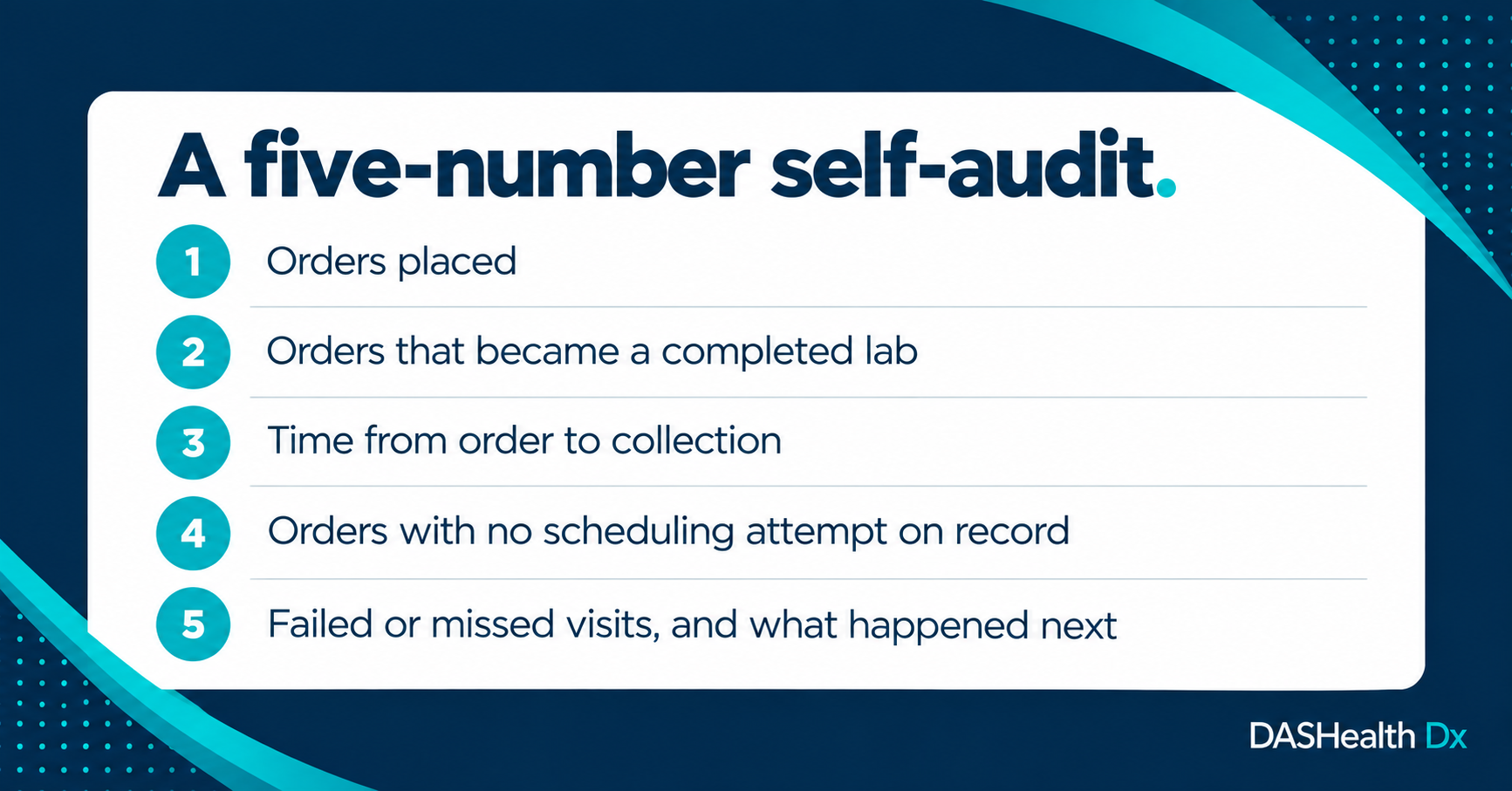
Pull five numbers for one measure or one member population.
- How many lab orders were placed in the period?
- How many of those turned into a completed lab?
- How long the completed ones took, from order to collection.
- How many orders had no scheduling attempt on record.
- How many had a failed or missed visit, and what happened next.
You do not need perfect data. You need enough to see which of the four gaps above is biggest. That tells you what to ask a partner to fix first.
What to require from a mobile specimen collection partner
Once you know your biggest gap, hold every vendor to the same short list.
- A workforce you can identify. Ask who performs the collection. DASHealth Dx uses directly-employed technicians.
- Confirmation you can see. Ask how your team learns a collection is done. Our clients receive a notification through the DASHealth Dx client portal when each collection is completed.
- A plan for failed visits. Ask what happens when a visit does not go through. At DASHealth Dx, we keep contacting the patient. If the patient cannot be reached, we notify the ordering party.
- Consistent training. Technicians are trained to consistent standards through our centralized operations team.
- An honest answer about new markets. When a program requires a market we do not currently staff, we confirm feasibility and build local coverage before volume moves.
How DASHealth Dx approaches national programs
DASHealth Dx offers national mobile specimen collection through a centrally coordinated service model that supports programs across U.S. markets. That does not mean a technician in every ZIP code or guaranteed immediate coverage in every geography. We confirm coverage against the markets your program needs before volume moves.
Operations are centralized and collection protocols are standardized across the markets we serve. DASHealth Dx maintains a 99% collection completion rate.
We will not promise this model produces a specific result in your network. Your members, markets, and measures are your own. The right test is your real gaps.
No. DASHealth Dx collects and delivers specimens. The performing laboratory handles testing and reporting.
We keep contacting the patient. If the patient cannot be reached, we notify the ordering party.
That is the question to test first. We confirm coverage across supported markets against your program's needs before volume moves.
Let's look at your gaps
If you lead quality, care management, or vendor sourcing for a health plan or MCO, bring us one measure and one population. We'll look at where ordered labs are not turning into completed ones and whether our model fits.
Talk with our team about closing lab-completion gaps across your network.